-
 Venues
-
 Teams
-
 Events
-
 Games
Venues
Teams
Events
Games
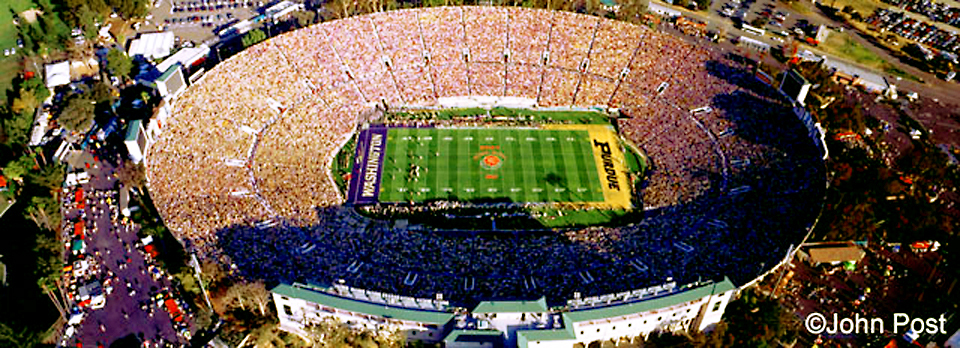
The Pasadena City Council approves a $152 million major renovation plan in 2010. The multi-year project includes a new, expanded press box with luxury seating, new video boards, removal of obstructed seats, re-installation of historical sideline hedges, widening tunnels and aisles, and an increased number of concession stands and restrooms.
Effort is taken to preserve and enhance the traditional look of the stadium and its surrounding environment. The main video board (30ft x 77ft from Daktronics) is mounted on the north endzone and flanked by three low-profile digital panels on either side. The south endzone features a custom scoreboard inspired by the stadium's past, with an analog clock and scoring/game details. The new scoreboard restores the symmetrical look to the southern facade of the stadium.
Despite cost overruns and funding gaps, the renovation is completed in time for the 100th Rose Bowl game.
Name: Rose Bowl
Capacity: 92,542
Surface: Grass
The Pasadena City Council approves a $21.5 million bond to make upgrades to the aging stadium as required by its primary tenant, UCLA, to renew its lease.
The renovation begins following the 1996 season. Individual seats replace the bleachers along the sidelines, reducing official capacity to 92,542. New video boards are mounted above the rim of the bowl in each endzone, disrupting the iconic southern facade in the process. A new sound system, additional restrooms, concession stands, and locker room upgrades are also included in the renovation.
Name: Rose Bowl
Capacity: 92,542
Surface: Grass
Seatbacks are added to the bleacher seating.
Name: Rose Bowl
Capacity: 104,594
Surface: Grass
Additional seats are added to fill in the lower section of the endzones, bringing the official capacity to 104,594, the largest in the country.
Name: Rose Bowl
Capacity: 104,594
Surface: Grass
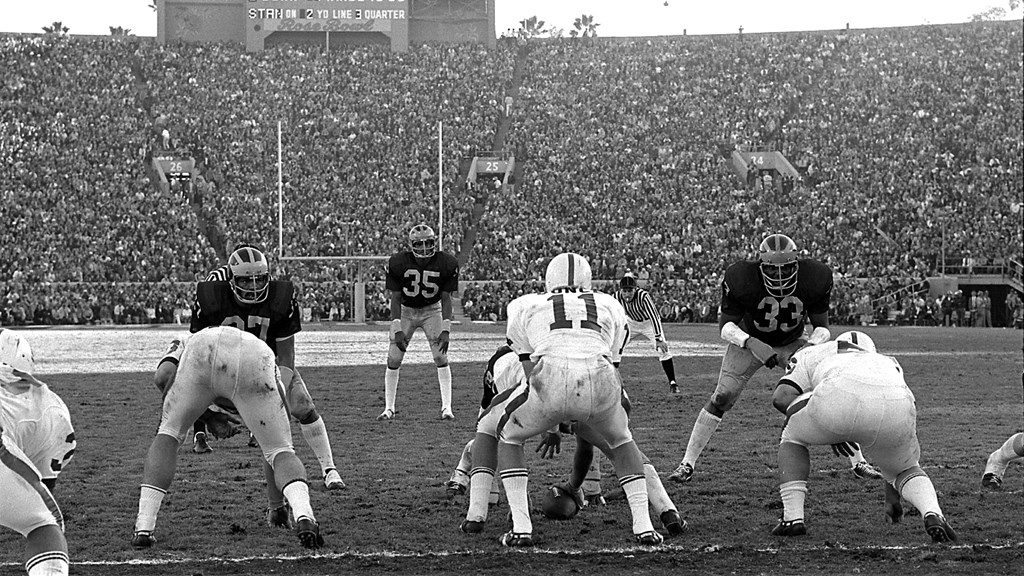
NBC nationally broadcasts the 1962 Rose Bowl game in color, a first for a college football game.
Name: Rose Bowl
Capacity: 100,983
Surface: Grass
The 1952 Rose Bowl becomes the first nationally telecast bowl game, broadcasted on NBC. The event came just three months after the Duke vs. Pittsburgh football game became the first nationally telecast live sporting event of any kind. NBC would purchase the exclusive rights to telecast a single college football game each week in the following season, paying the NCAA $1,144,000.
Name: Rose Bowl
Capacity: 100,983
Surface: Grass
The second endzone expansion is completed, bringing a uniform level around the bowl and taking capacity over 100,000.
Name: Rose Bowl
Capacity: 100,983
Surface: Grass
10,733 seats are added before the 1949 Rose Bowl in phase I of expanding the endzone seats to meet the top rim of the sidelines.
Name: Rose Bowl
Capacity: 94,410
Surface: Grass
W6XYZ, licensed as an experimental station by the FCC in 1939, telecasts the 1947 Rose Bowl, the first bowl game telecast in the country. The crew purchases their own tickets to the game from scalpers after being denied entry from the workers at the ticket gate who were unfamiliar with the telecast agreement. W6XYZ would go on to be fully licensed by the FCC as KTLA later that month.
Name: Rose Bowl
Capacity: 83,677
Surface: Grass
The original wooden bleacher sections are replaced, increasing capacity to 83,677 before the 1931 Rose Bowl game.
Name: Rose Bowl
Capacity: 83,677
Surface: Grass
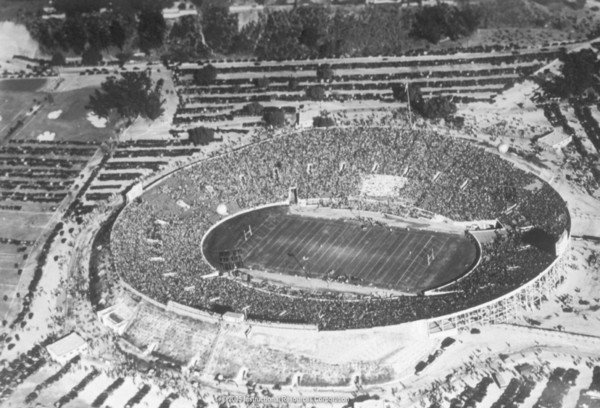
The open, south end of the horseshoe is enclosed to add 19,000 seats.
Name: Rose Bowl
Capacity: 76,000
Surface: Grass
In 1926, the Radio Corporation of America (RCA) forms the first national radio network (National Broadcasting Company, or NBC.) The 1927 Rose Bowl is chosen as the first nationwide broadcast. Graham McNamee, already a prominent sports announcer, calls the play-by-play. NBC would go on to purchase the broadcast rights to the game for another seven years.
Name: Rose Bowl
Capacity: 57,000
Surface: Grass
The original stadium name is short-lived, as it quickly changes to "Rose Bowl" in time for its official dedication at the 1923 Rose Bowl game. After undefeated California declines to participate, 9-1 USC accepts an invitation to play. They would go on to defeat Penn State 14-3.
Name: Rose Bowl
Capacity: 57,000
Surface: Grass
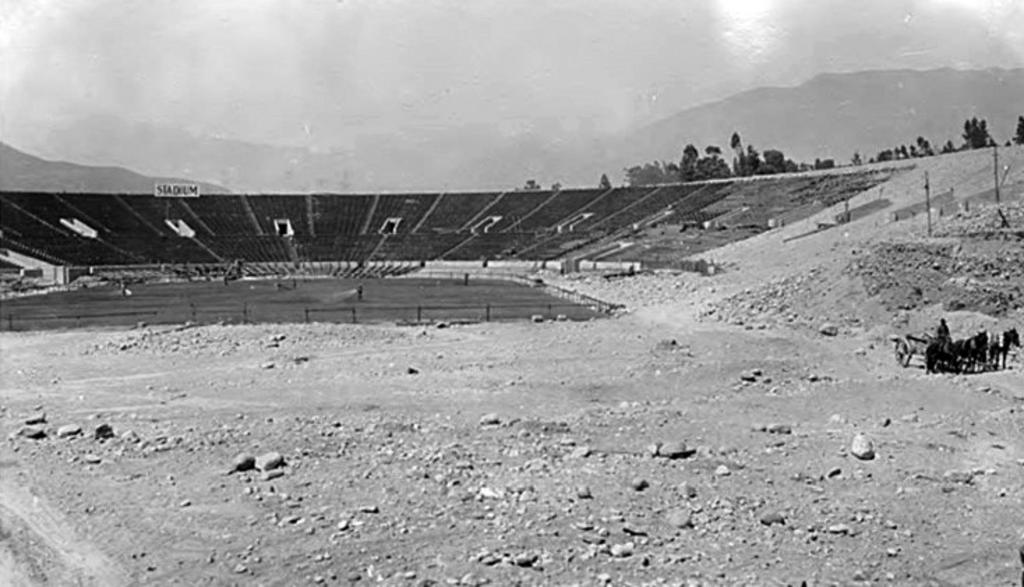
The new Tournament of Roses Stadium is built at a cost of $272,198 and a capacity of 57,000 in a horseshoe configuration. The stadium design is influenced by the Yale Bowl, which was built seven years earlier. California defeats USC 12-0 on October 28, 1922 in the inaugural game.
Name: Tournament of Roses Stadium
Capacity: 57,000
Surface: Grass